




Newsroom / Center News
Romania’s Renewable Energy Surge: A Market Entering Its Acceleration Phase
Romania is emerging as one of the most dynamic clean-energy markets in Southeast Europe, having reached a critical inflection point in its energy transition. As documented in the Romanian Energy Market Report 2025 (REMARC), co-authored by CIGA Energy Advisory and the Hellenic Association for Energy Economics (HAEE), the country already benefits from one of the cleanest electricity generation mixes in the region.
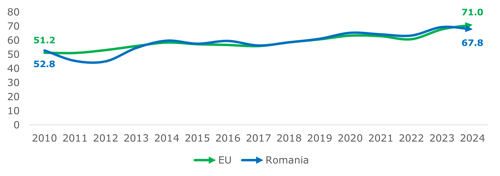
Approximately 68% of electricity generation originates from low-carbon sources, primarily hydropower and nuclear energy. Despite this favourable structural starting point, Romania remains underdeveloped in modern renewable technologies. Installed wind capacity has stagnated at around 3 GW for nearly a decade, while solar—although still modest in absolute terms—has emerged as the most dynamic segment, doubling in capacity between 2021 and 2023. This combination of a clean legacy system and delayed deployment of variable renewables helps explain both the scale and urgency of the current investment wave.

What emerges clearly from the data is that Romania has entered an acceleration phase. Solar capacity additions have gained momentum, while wind power is poised to restart its growth trajectory following the most recent Contract-for-Difference (CfD) auction rounds. The December 2024 CfD auction alone awarded 1.5 GW of new capacity—predominantly wind and solar—at highly competitive strike prices, establishing a robust project pipeline for realization between 2025 and 2030. Subsequent auction rounds in 2025 cleared at even lower prices, confirming Romania’s position as one of the most cost-efficient renewable energy markets in Southeast Europe.
This rapid expansion, however, is accompanied by growing system-level challenges. The REMARC report highlights a marked increase in wholesale price volatility, including a rising number of negative day-ahead price hours during periods of high renewable generation. These developments are symptomatic of a system in which renewable capacity is expanding faster than available flexibility. Grid constraints are becoming more pronounced, balancing requirements are intensifying, and the need for large-scale energy storage is now widely recognized as a structural priority. This is further evidenced by the extraordinary volume of grid connection permits (ATR) issued for BESS projects—exceeding 6,900 by late 2025—although only a limited share has progressed to full grid connection agreements. Importantly, the government’s decision to remove double charging for storage in 2024 signals a clear policy commitment to unlocking this critical enabling technology.

Beyond renewables, Romania is undergoing a broader structural transformation of its energy sector. The gradual phase-out of coal is accelerating the shift toward a more diversified and lower-carbon energy mix. In natural gas, the country benefits from a strong domestic production base covering up to 90% of national demand, providing one of the highest levels of supply security in Europe. Nevertheless, seasonal imports persist during winter months, while an aging gas transmission network—much of it more than 30 years old—poses challenges related to efficiency and operational safety.
At the demand side, structural change is equally evident. The rapid expansion of the prosumer segment, which surpassed 240,000 installations in 2025, has significantly increased distributed solar capacity and further complicated system operation—reinforcing the need for flexibility, digitalization, and advanced market design.
When viewed holistically, Romania appears to be transitioning from a relatively stable hydro-nuclear backbone to a far more complex, multi-layered clean-energy system. Over the coming decade, success will be determined not solely by the volume of renewable capacity installed, but by the ability of market participants to integrate storage, manage intermittency, and operate across multiple market segments with agility.
Within this evolving landscape, HELLENiQ ENERGY has moved decisively to establish a strong and strategically coherent presence in Romania’s renewable energy market. The Group entered the market in 2023 with a solar portfolio exceeding 800 MW, including a 211 MW cluster already under agreement and a framework for the development of up to an additional 600 MW of photovoltaic capacity. This positioning was further reinforced in 2025 through the acquisition of two ready-to-build wind projects with a combined capacity of 282 MW: a 96 MW wind farm and a 186 MW hybrid-ready wind project integrating a Battery Energy Storage System (BESS) of 186 MWh. This latter investment is particularly significant, as it marks the Group’s deliberate entry into flexibility and balancing services—segments that are becoming increasingly critical as renewable penetration accelerates and market volatility intensifies. HELLENiQ ENERGY’s mature and operating clean-energy portfolio has now reached approximately 1.5 GW, corresponding to nearly 75% of its 2030 target of 2 GW.
Ultimately, Romania’s energy transition illustrates a broader structural shift taking place across Southeast Europe. Electricity systems that were historically anchored in stable, low-carbon baseload generation are evolving into markets defined by higher variability, increased decentralization, and growing operational complexity. In this new phase, success will depend less on the absolute volume of renewable capacity deployed and more on the ability to integrate flexibility, manage intermittency, and align market design with physical system constraints.
Romania’s experience underscores that the next stage of the transition will be shaped by how effectively renewable expansion is matched with storage, grid reinforcement, and balancing mechanisms. As such, the country offers a valuable reference point for policymakers, system operators, and investors across the region who are navigating similar challenges and opportunities in the path toward a resilient, low-carbon electricity system.