
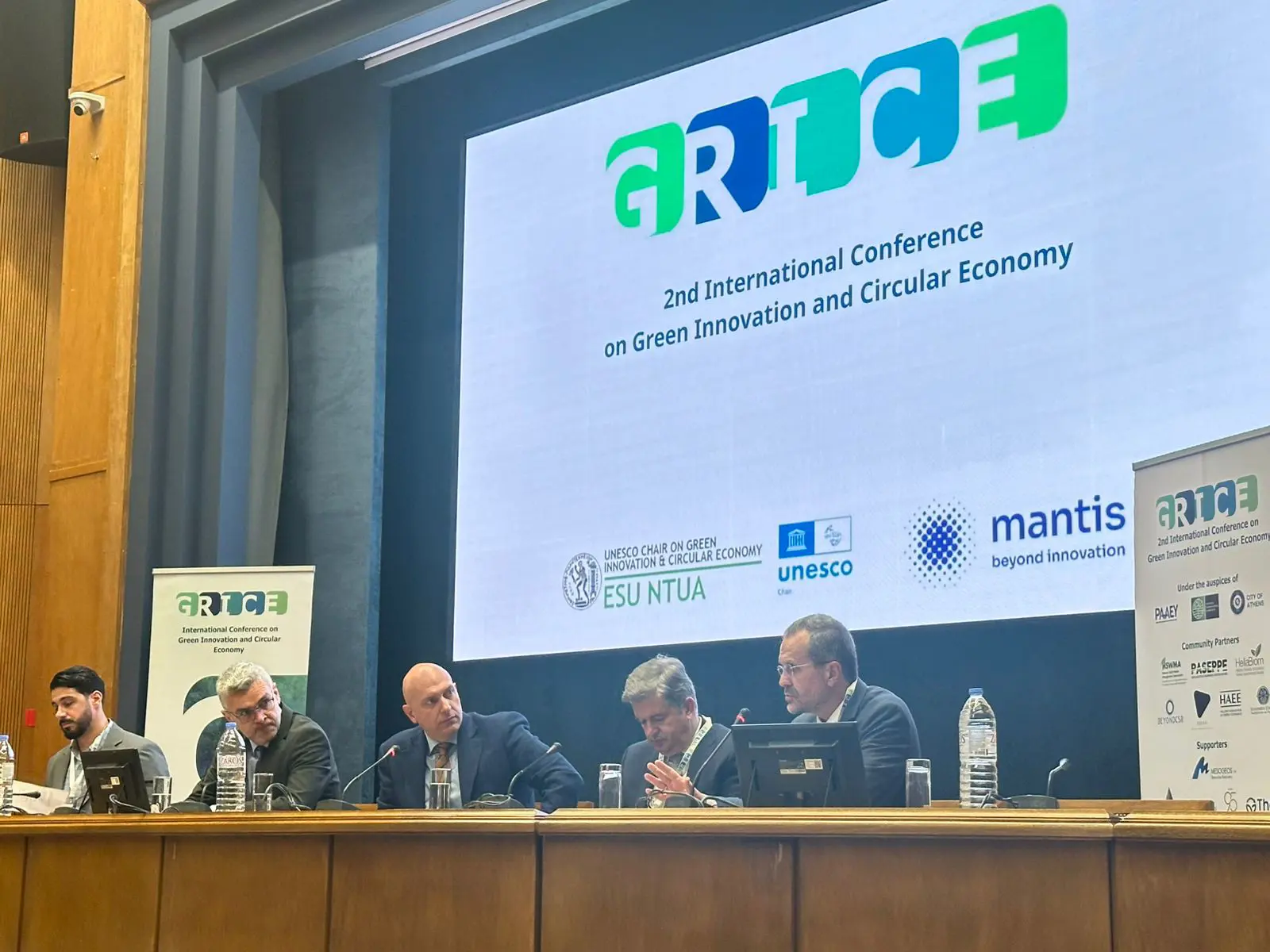
The panel “Innovation Meets Education: Preparing the Next Generation of Energy Leaders”, held during the GRI-CE Conference 2026 and organized by the UNESCO Chair on Green Innovation & Circular Economy of NTUA, examined one of the most pressing challenges facing the energy sector today:
How to prepare the workforce and leadership of tomorrow for a rapidly evolving energy landscape.
The panel brought together representatives from academia, industry, and innovation:
- Alexandros Tzadimas (Group Human Resources & Administrative Services General Manager, HELLENiQ ENERGY)
- Prof. Kostas Axarloglou (Dean, Alba Graduate Business School)
- Prof. Athanasios Dagoumas (Associate Professor in Energy and Resource Economics, University of Piraeus & Chief Research Engineer, DeepRunner AI)
The session was coordinated by the HELLENiQ ENERGY Center for Sustainability and Energy @ Alba Graduate Business School and moderated by its Director, Prof. Dr. Kostas Andriosopoulos.
The discussion focused on the intersection of education, technological transformation, workforce adaptation, and innovation, highlighting the growing importance of upskilling and reskilling across the energy value chain.
The Energy Transition and the Workforce Challenge
The global energy sector is undergoing a profound transformation driven by decarbonization targets, digitalization, geopolitical uncertainty, and the rapid deployment of emerging technologies. These developments are reshaping not only energy systems and business models, but also the competencies required by the workforce.
Energy companies are increasingly facing a dual challenge: adapting existing workforce capabilities while simultaneously preparing new professionals for roles that did not previously exist. In this context, upskilling has become a strategic necessity rather than a supplementary corporate initiative.
Modern energy professionals must increasingly combine technical expertise with digital literacy, strategic thinking, sustainability awareness, and adaptability.
As organizations integrate AI-driven systems, data analytics, automation, and smart infrastructure into their operations, the demand for multidisciplinary skill sets continues to grow.
Reskilling Traditional Energy Roles
An accelerating need for reskilling across traditional energy roles. As the energy industry transitions toward cleaner and more sustainable models, many existing job profiles are evolving significantly.
Professionals working in conventional operational environments must now develop competencies related to renewable energy systems, digital monitoring technologies, energy markets, data interpretation, and sustainability frameworks. Energy transition strategies will depend not only on technological investment, but also on the ability of organizations to effectively support workforce adaptation.
Lifelong learning and continuous professional development are critical factors for maintaining competitiveness in an increasingly dynamic energy market.
Artificial Intelligence, Data, and Cybersecurity
AI and data-driven decision-making are becoming increasingly important in modern energy systems. AI technologies are transforming energy trading, forecasting, grid management, predictive maintenance, and operational optimization.
Future energy professionals will need a stronger understanding of data analytics, digital systems, and algorithmic thinking. At the same time, the increasing digitalization of energy infrastructure also introduces new cybersecurity challenges.
As energy systems become more interconnected and dependent on digital platforms, cybersecurity is emerging as a core component of operational resilience and energy security.
Integrating cybersecurity awareness and digital risk management into both academic curricula and corporate training programs is more timely than ever.
Bridging Academia and Industry
Stronger collaboration between universities, businesses, research centers, and start-ups is essential to bridge the gap between theoretical education and real-world market needs.
Interdisciplinary education is becoming a key priority, as energy increasingly intersects with finance, strategy, technology, sustainability, and geopolitics. Future professionals must be able to operate across disciplines and adapt to rapidly changing technological and regulatory environments.
Closer partnerships between academia and industry are critical for developing practical learning experiences, applied research initiatives, and innovation ecosystems capable of supporting the next generation of energy talent.
As the energy sector continues to evolve, investing in people, knowledge, and adaptive skills will be just as important as investing in technology and infrastructure. Preparing a resilient, digitally skilled, and innovation-oriented workforce will be fundamental to ensuring a successful and sustainable energy transition in the years ahead.