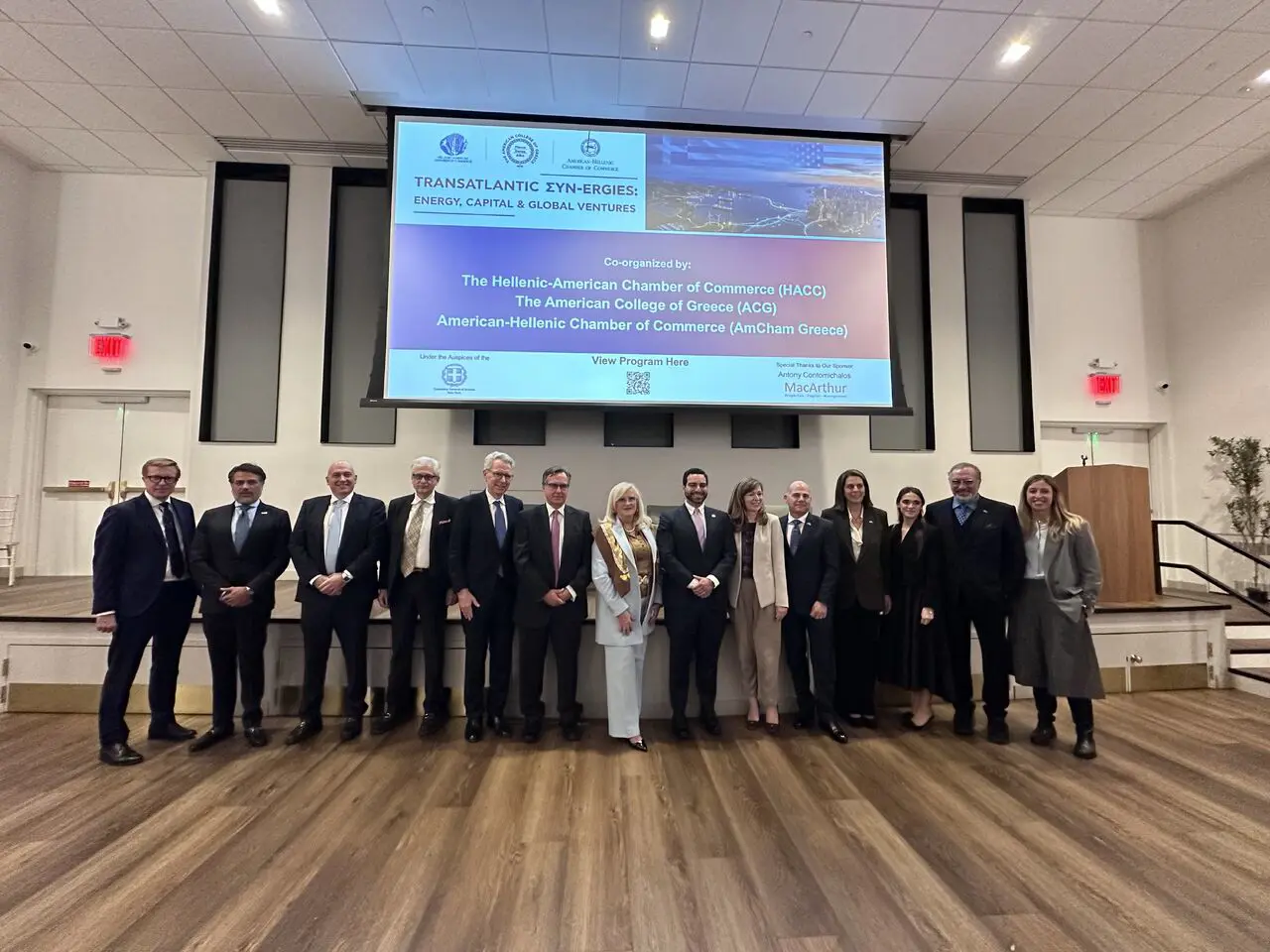
Representatives from government, the financial sector, the energy industry, academia and the maritime community convened at Chiotes Hall in New York City for Transatlantic ΣΥΝ-ERGIES: Energy, Capital & Global Ventures, a high-level conference co-organized by the Hellenic-American Chamber of Commerce (HACC), The American College of Greece (ACG), and the American-Hellenic Chamber of Commerce (AmCham Greece), under the auspices of the Consulate General of Greece in New York.
Against a backdrop of geopolitical realignment, evolving global energy markets and accelerating technological transformation, the conference provided a platform for examining the strategic dimensions of U.S.–Greece cooperation. Discussions focused on the role of transatlantic partnerships in mobilizing investment, strengthening regional and international energy security, advancing technological innovation and developing the human capital required to sustain long-term economic growth. A central theme throughout the proceedings was the need to translate the strong strategic alignment between the two countries into tangible initiatives, institutional partnerships, and cross-border investment opportunities.
A key highlight of the conference was the fireside discussion, “From Knowledge to Impact: Building Transatlantic Bridges Through Education,” featuring Edward C. Wingenbach, PhD, President of The American College of Greece, and Eraklis A. Diamataris of The National Herald.
The discussion examined the strategic contribution of higher education to economic development, institutional cooperation, and the strengthening of bilateral relations. Emphasis was placed on the capacity of academic institutions to act as catalysts for innovation, knowledge transfer and the development of highly skilled professionals in sectors undergoing profound structural transformation.
President Wingenbach outlined ACG’s expanding international academic framework and its commitment to addressing emerging educational and professional demands across critical fields, including cybersecurity, life sciences and executive education in energy management through Alba Graduate Business School. He further highlighted the institution’s role in strengthening Greece’s position as an international education destination, retaining and developing domestic talent while fostering stronger connections with the Greek-American diaspora through academic mobility and cultural exchange programmes.
The discussion also underscored the importance of sustained institutional engagement in building durable international partnerships. Mr. Diamataris highlighted the contribution of cross-border educational opportunities and diaspora networks to the development of bilateral relations, emphasizing their potential to reinforce economic competitiveness, facilitate knowledge exchange and create lasting connections between the two countries.
The conference’s strategic energy dialogue was brought together in the panel discussion “U.S.–Greece Strategic Energy Partnership: From Energy Security to the Digital Economy,” moderated by Prof. Dr. Kostas Andriosopoulos, Director of the HELLENiQ ENERGY Center for Sustainability and Energy at Alba Graduate Business School and Chair of the Energy Committee at AmCham Greece.
The panel explored the evolving role of Greece within the broader transatlantic and regional energy architecture, particularly its potential to serve as a strategic gateway connecting the United States, Europe and the Eastern Mediterranean. Special attention was devoted to the development of the Vertical Gas Corridor, the expansion of U.S. liquefied natural gas (LNG) exports into European markets and the associated infrastructure requirements for strengthening diversification, supply security and regional energy connectivity.
Beyond conventional energy security considerations, the discussion addressed the growing interdependence between energy infrastructure and the digital economy. The panel examined the importance of coordinated infrastructure development, resilient energy systems and effective regional market integration in supporting the next phase of economic and technological growth.
Joshua Volz emphasized that the U.S.–Greece strategic partnership is founded on enduring shared principles and interests that extend beyond domestic political cycles. He also acknowledged Greece’s progress in establishing a favourable regulatory and commercial environment capable of attracting international investment and supporting the development of strategic energy infrastructure.
Addressing the intersection of energy security and global trade, Nikolas P. Tsakos highlighted the strategic importance of the Greek merchant fleet in maintaining the continuity and resilience of international supply chains, particularly amid geopolitical uncertainty and disruptions to global trade routes. He also presented initiatives aimed at advancing maritime education and workforce development through the Tsakos family’s Merchant Marine Academy on Chios. Particular emphasis was placed on opportunities for international training programmes and potential cooperation with U.S. shipyards in the fields of vessel maintenance and technical expertise.
From an academic perspective, Ted Loch-Temzelides highlighted the importance of integrating research, energy market development and cross-border infrastructure planning to address the structural challenges facing regional energy systems. He underscored the contribution of regional electricity market coupling, energy storage optimization and coordinated infrastructure development across Greece, Cyprus and Israel to reducing market fragmentation, improving system efficiency and creating the conditions necessary to attract long-term institutional investment.
In his concluding remarks, Prof. Dr. Andriosopoulos emphasized that the future of the U.S.–Greece strategic partnership will increasingly depend on the ability to align energy policy, infrastructure investment, academic research and private-sector expertise within a coherent framework of cooperation.
Energy security can no longer be approached exclusively through the lens of supply diversification. It requires an integrated strategy encompassing resilient infrastructure, interconnected markets, technological innovation, maritime capabilities and the development of specialized human capital. Equally important is the role of academic and institutional partnerships in translating knowledge into commercially viable solutions and sustainable economic opportunities.
Ultimately, Transatlantic ΣΥΝ-ERGIES reaffirmed the strategic value of closer U.S.–Greece engagement, highlighting the complementary strengths of the two countries in energy, shipping, education and investment. By fostering dialogue among policymakers, industry leaders, academics and investors, the conference contributed to advancing a shared vision for a more interconnected, secure and competitive transatlantic economic landscape.
For those who were unable to attend, the full conference discussions are available to watch on YouTube, offering an opportunity to revisit the key insights and perspectives shared by the speakers.