
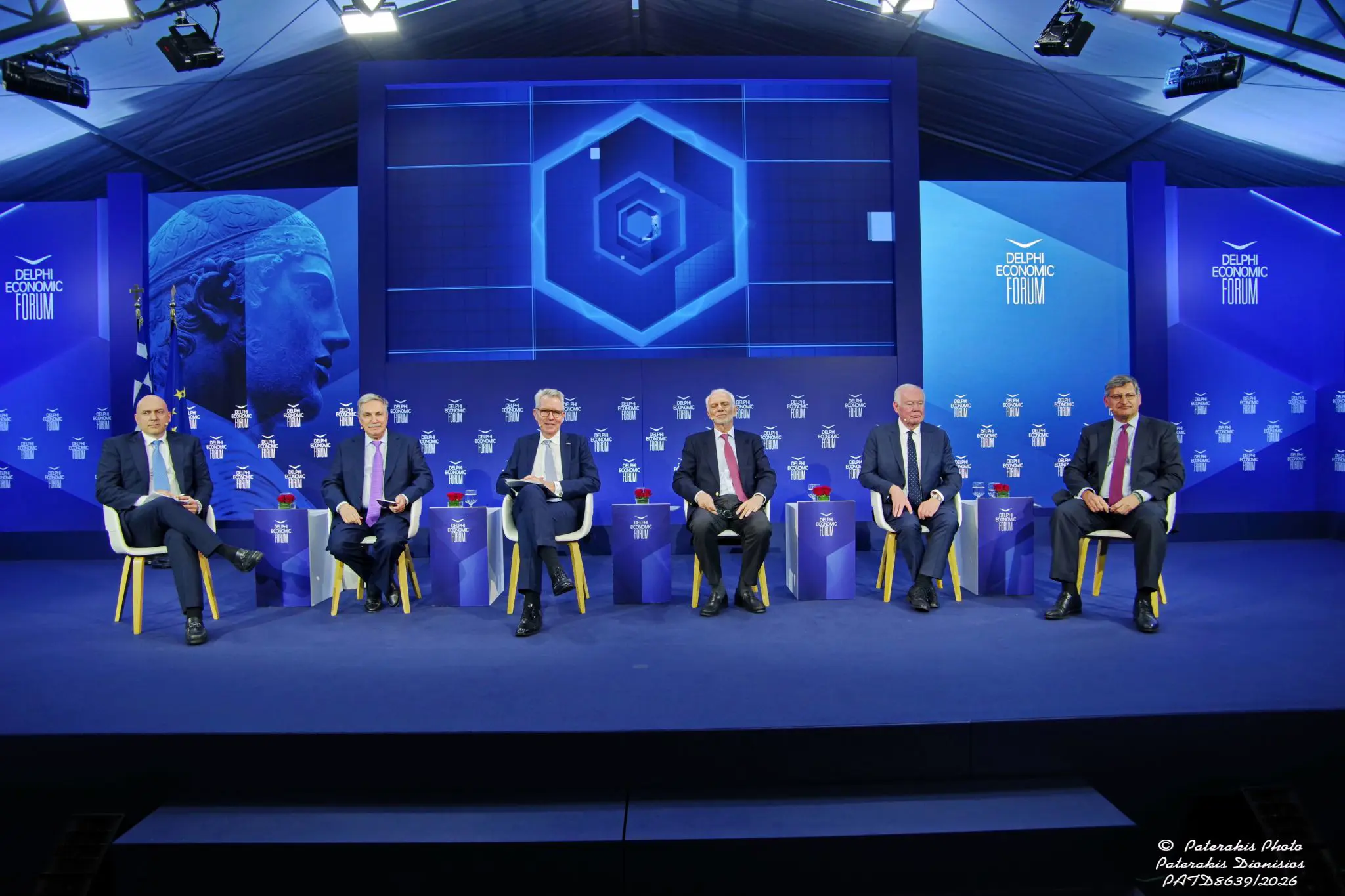
The panel Energy Transition: Strategy, Supply and Capital Flows at the Delphi Economic Forum XI explored how the global energy system is being reshaped by a convergence of geopolitical tensions, market volatility, and the accelerating energy transition, creating a new environment defined by uncertainty and structural change.
The panel brought together a diverse group of leaders:
- Geoffrey Pyatt (Senior Managing Director for Energy and Critical Minerals at McLarty Associates; Assistant Secretary of State for Energy Resources (2022–2025), USA)
- Pavlos Mylonas (Chief Executive Officer, National Bank of Greece, Greece)
- Charles Hendry (Distinguished Fellow, Atlantic Council, United Kingdom)
- Petros Tzannetakis (Deputy CEO, Motor Oil, Greece)
- Anthony Papadimitriou (President, Onassis Foundation, Greece)
Together, they explored how the global energy system is being reshaped by geopolitical tensions, market volatility, and the accelerating energy transition, highlighting the need for energy security, diversification, and long-term strategic investment in an increasingly uncertain and complex environment.
This evolving landscape is increasingly defined by uncertainty and structural change, making decision-making in the energy sector inherently strategic, particularly given the long-term nature of investments, whose impacts extend well beyond 2030.
Recent crises have exposed deep vulnerabilities in global energy systems, reinforcing the idea that energy security can no longer be taken for granted. Disruptions in key energy flows, instability in critical regions, and shifting global power dynamics have led to a fragmentation of energy markets. As a result, security of supply is now prioritized over pure efficiency, pushing countries to reassess their dependence on specific suppliers and transport routes. Europe, in particular, has experienced heightened exposure, accelerating efforts toward diversification of energy sources and supply corridors.
At the same time, even when renewable energy technologies are cost-competitive, the importance of system security remains fundamental to ensuring both affordability and stability. Energy crises are no longer isolated events but part of a recurring and systemic pattern, making the cost of energy insecurity significantly higher than the cost of prevention.
Within this context, the strategic use of geography and infrastructure becomes increasingly important, especially for countries positioned to act as regional energy hubs. However, reliance on carbon-intensive activities, such as refining, presents challenges due to environmental impacts, reinforcing the need for energy mix diversification and long-term investment planning. At the same time, ongoing instability continues to undermine investor confidence.
A central theme is the critical role of government policy, as the energy sector cannot function effectively under market forces alone. Achieving a balance between security, affordability, and sustainability requires clear, stable, and long-term regulatory frameworks. Mechanisms that provide predictability and revenue visibility, such as guaranteed pricing or structured contracts, are essential to mobilize capital, particularly for capital-intensive low-carbon technologies.
From an industry perspective, companies are navigating a complex dual mandate: maintaining profitability in traditional energy operations while simultaneously investing in decarbonization. This has led to balanced strategies, with continued investment in conventional assets alongside expansion into renewables (wind, solar) and energy storage. However, this transition is complicated by regulatory inconsistencies, infrastructure gaps, and unpredictable market conditions.
Financing emerges as one of the most significant challenges. Financial institutions, which typically favor stable and predictable returns, are now faced with projects characterized by long time horizons, volatile revenues, and regulatory uncertainty. The rapid growth of renewables has introduced additional complexities, including grid saturation, price volatility, and instances of zero or negative pricing, all of which affect project bankability. At the same time, uncertainty surrounding emerging technologies, such as energy storage, further increases investment risk, highlighting the need for robust infrastructure, improved market design, and regulatory stability.
Another layer of complexity is added by energy transportation, particularly through shipping, which operates within a highly volatile geopolitical environment. Disruptions in this sector can immediately impact global supply-demand dynamics, further amplifying uncertainty.
In this new reality, success will depend on the ability of governments, industry, and financial institutions to adapt quickly, coordinate effectively, and plan for the long term despite short-term uncertainty.